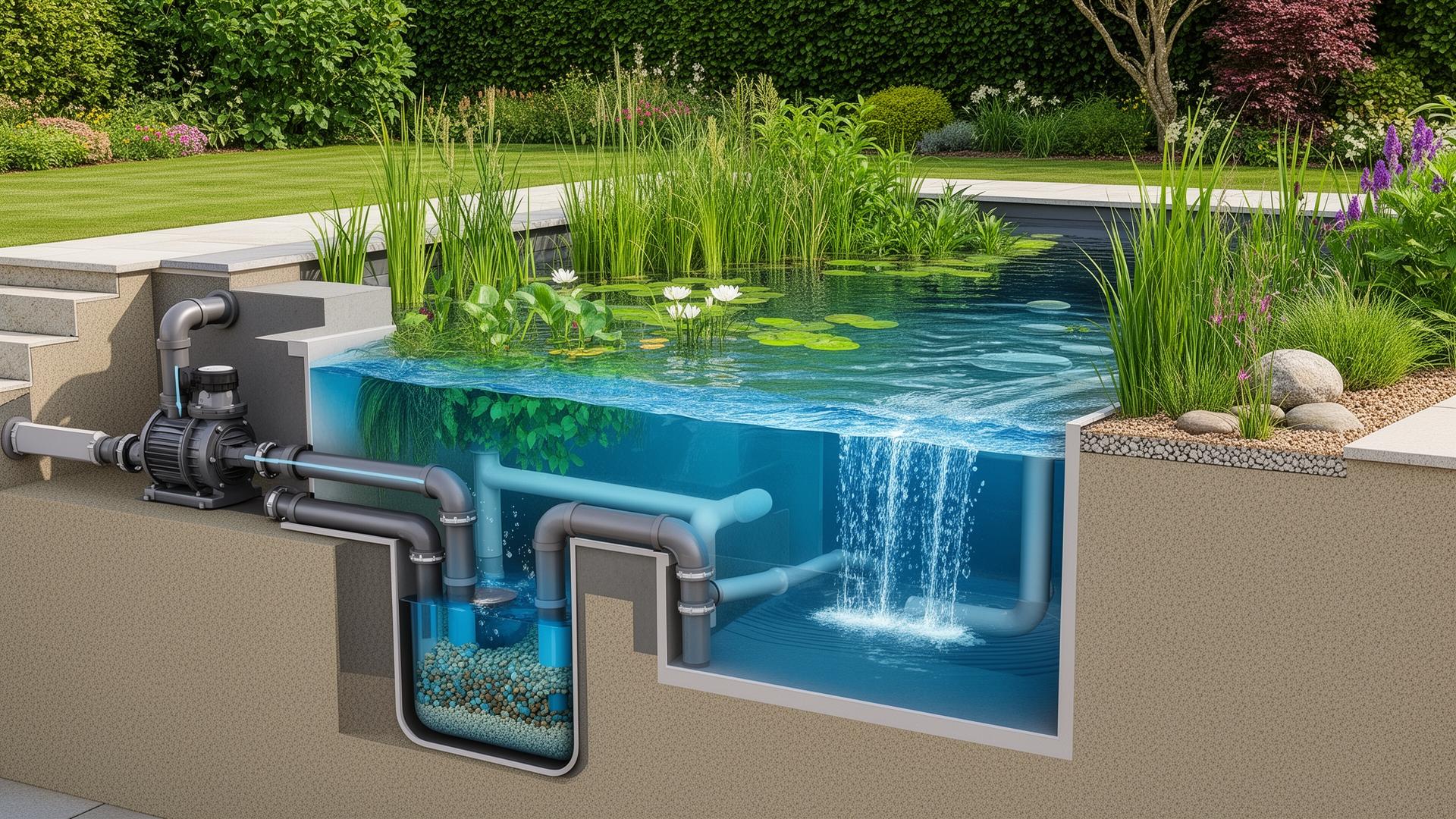
Natural Swimming Pool Filtration Systems: Pump vs Gravity UK Guide
Compare pump-fed and gravity-fed filtration systems for natural swimming pools. Understand the costs, maintenance, and benefits of each approach for UK gardens.

Jon Edwards
Founder & Lead Designer
- Pump systems push water through filters; gravity systems pull it by level change.
- Each approach has trade-offs in energy use, maintenance, and installation.
- Site constraints and performance goals should drive the choice.
Understanding Natural Pool Filtration
Every natural swimming pool needs a filtration system to circulate water through the regeneration zone. The two main approaches—pump-fed and gravity-fed—each have distinct advantages for UK installations.
Pump-Fed Filtration Systems
The most common approach for natural swimming pools in the UK.
How It Works
- Electric pumps move water from the swimming zone
- Water flows through planted regeneration areas
- Filtered water returns to the swimming zone
- Continuous circulation maintains water quality
Advantages of Pump Systems
- Flexible design: Pool and regeneration zone can be at the same level
- Compact footprint: Ideal for smaller UK gardens
- Precise control: Adjustable flow rates
- Proven reliability: Widely used across Europe
- Lower construction cost: Simpler excavation requirements
Considerations
- Running costs: £200-400/year electricity
- Pump maintenance: Service every 2-3 years
- Noise: Modern pumps are near-silent
- Power dependency: Requires constant electricity
Typical UK Pump System Costs (see our [10-year cost comparison](/blog/natural-pool-10-year-cost-comparison) for long-term analysis)
| Component | Cost Range |
|---|---|
| Main circulation pump | £800-2,000 |
| Skimmer pump | £400-800 |
| UV clarifier (optional) | £300-600 |
| Installation | £1,500-3,000 |
| **Total** | **£3,000-6,400** |
Gravity-Fed Filtration Systems
A more naturalistic approach favoured by purist designers.
How It Works
- Water flows downhill from swimming zone to regeneration area
- Gravity moves water through planted filter beds
- A single pump returns water to the swimming zone
- Natural head pressure drives most circulation
Advantages of Gravity Systems
- Lower running costs: Reduced pump usage (£100-200/year)
- More naturalistic: Mimics natural water flow
- Fewer moving parts: Less mechanical maintenance
- Quieter operation: Minimal pump noise
- Power resilience: Works partially during outages
Considerations
- Site requirements: Needs level changes (30-50cm minimum)
- Larger footprint: Regeneration zone often larger
- Construction complexity: More excavation work
- Higher build cost: Additional groundworks required
Typical UK Gravity System Costs
| Component | Cost Range |
|---|---|
| Return pump | £600-1,200 |
| Weir/overflow systems | £1,000-2,500 |
| Additional excavation | £3,000-8,000 |
| Installation | £2,000-4,000 |
| **Total** | **£6,600-15,700** |
Which System Suits Your Garden?
Choose Pump-Fed If:
- Your garden is relatively flat
- Space is limited (under 100m² total)
- You want lower upfront costs
- Minimising disruption is important
- Contemporary design is preferred
Choose Gravity-Fed If:
- Your garden has natural slopes
- You have generous space (150m²+)
- Lower running costs are priority
- You prefer a naturalistic aesthetic
- Maximum wildlife benefit is desired
Hybrid Systems
Many UK natural swimming pools use a combination:
Best of Both Worlds
- Gravity flow through main regeneration zone
- Pump-assisted surface skimming
- Backup circulation for peak demand
- Optimised for UK climate conditions
Hybrid System Benefits
- Reduced electricity consumption
- Flexible operation modes
- Redundancy for peace of mind
- Adaptable to seasonal changes
Filtration Capacity: Getting the Balance Right
The 30-50% Rule
Your regeneration zone should be 30-50% of total water surface area:
- 30%: Pump systems with high circulation
- 40%: Standard recommendation for UK climate
- 50%: Gravity systems or high bather loads
Flow Rate Guidelines
- Minimum: Entire pool volume circulated every 24 hours
- Recommended: Full circulation every 12 hours
- Peak summer: Consider 8-hour circulation cycles
UV Clarifiers: Worth Adding?
Some UK installations include UV clarification as a backup. Understanding how natural pools stay clean helps decide if you need this:
Benefits
- Kills suspended algae spores
- Reduces green water risk
- Provides extra confidence
- Useful during establishment phase
Considerations
- Adds £300-600 to system cost
- £50-100/year running and bulb replacement
- Not essential for well-designed systems
- Can become a crutch for poor biology
Maintenance by System Type
For full seasonal care details, see our year-round maintenance guide.
Pump System Maintenance
- Monthly: Check skimmer baskets
- Quarterly: Inspect pump operation
- Annually: Professional service recommended
- Every 5-7 years: Pump replacement
Gravity System Maintenance
- Monthly: Clear any debris from weirs
- Quarterly: Check overflow channels
- Annually: Professional assessment
- Every 10+ years: Minimal component replacement
Making Your Decision
Our AI feasibility assessment analyses your garden's:
- Natural slopes and levels
- Available space
- Soil conditions
- Your aesthetic preferences
Upload a photo to receive system recommendations tailored to your specific site.
Frequently Asked Questions
What is the difference between pump-fed and gravity-fed natural pool filtration?
Pump-fed systems use electric pumps to circulate water and work on flat sites with lower construction costs (£3,000-6,400). Gravity-fed systems use natural slopes to move water, have lower running costs (£100-200/year vs £200-400), but require site level changes and cost more to build (£6,600-15,700).
How much does natural pool filtration cost to run?
Pump-fed systems cost £200-400/year in electricity. Gravity-fed systems cost £100-200/year. Both are significantly cheaper than chlorinated pools which cost £600-1,200/year just for electricity and heating.
Do natural pools need UV clarifiers?
UV clarifiers are optional and not essential for well-designed systems. They add £300-600 to system cost plus £50-100/year for running and bulb replacement. They can be useful during the establishment phase or as backup.
How often should water circulate in a natural pool?
Water should fully circulate every 12-24 hours minimum. During peak summer, 8-hour circulation cycles are recommended for optimal water quality.
See a Natural Pool in Your Garden
Upload a photo of your garden and our AI will render a natural swimming pool into your space. Free, instant, and no obligation.
Related Articles
Natural Swimming Pool Cost UK: Complete 2026 Guide
Discover the true cost of a natural swimming pool in the UK. From swimming pond cost factors to installation, we break down every expense for your project.
How Natural Swimming Pools Stay Clean Without Chemicals
Learn the science behind natural swimming pools and swimming ponds. Discover how aquatic plants and beneficial bacteria keep your water crystal clear—no chlorine needed.
Natural Swimming Pool Maintenance: Complete UK Year-Round Guide
Everything you need to know about maintaining a natural swimming pool or swimming pond through all four UK seasons. Simple tasks for lasting beauty.